Malicious QUIC C2 Traffic Detection based on Random Forest in Programmable Data Plane

Abstract
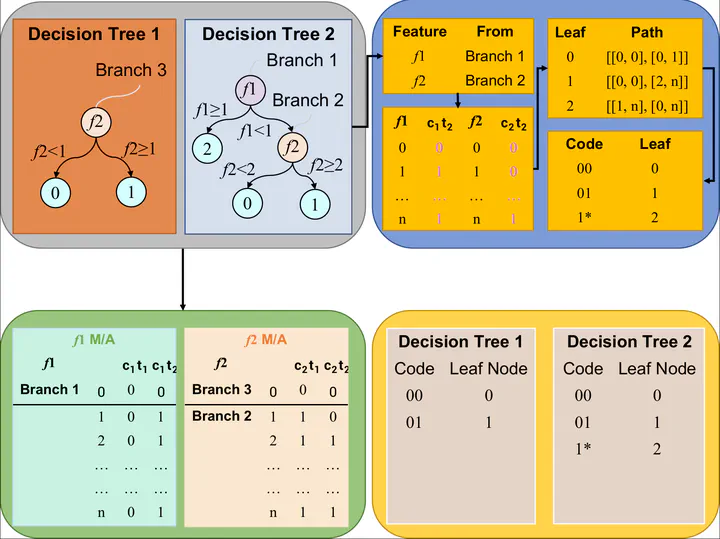
The widespread adoption of QUIC, an encrypted transport protocol, presents novel challenges for network security. Its underlying UDP-based connectionless design, full encryption, and multiplexed streams hinder traditional Deep Packet Inspection (DPI) and behavior-based detection methods. At the same time, Command-and-Control (C2) channels increasingly adopt QUIC to evade detection in advanced persistent threat (APT) attacks. This paper presents a real-time C2 detection framework built on programmable data planes and lightweight Random Forest classifiers. By embedding in-network telemetry (INT) metadata and compiling trained models into switch-executable rule tables, the proposed system enables near-source malicious flow detection at microsecond latency. We demonstrate the feasibility of deploying decision-tree-based inference within resource-constrained P4 switches, achieving 99.83% detection accuracy on server-based training and 82.1% on programmable hardware, with a 2–3 orders of magnitude reduction in inference latency. Our findings outline a novel design space for encrypted traffic inspection under performance and scalability constraints.
Type
Publication
ACM CoNEXT Workshop on In-Network Computing and AI for Distributed Systems
